Smell, Taste, or Color: When Is Colorado Tap Water Unsafe to Drink?
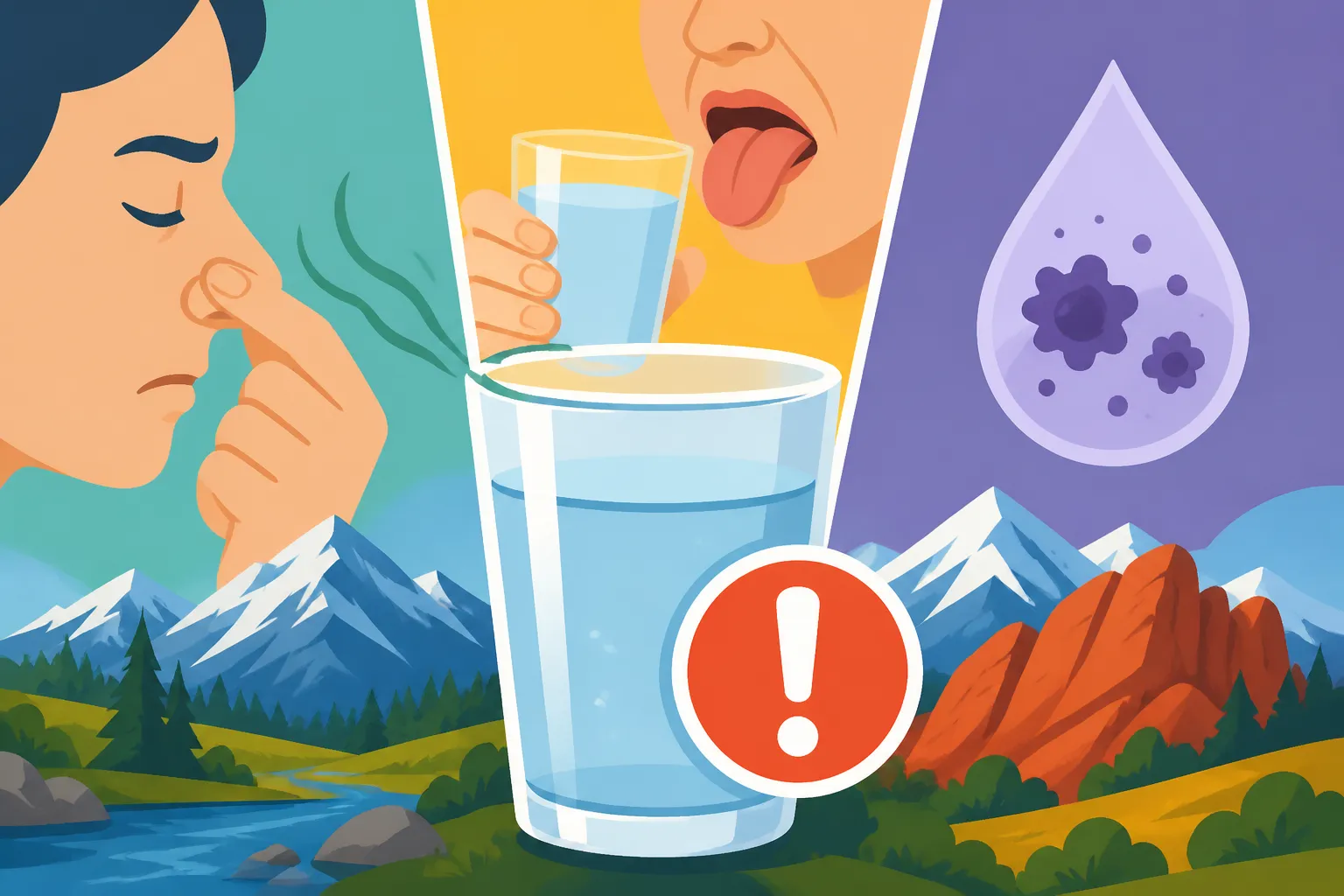
A sudden chlorine smell, rusty color, or unusual taste can make Colorado tap water seem unsafe. But sensory changes do not always mean a health hazard, and water that looks and tastes normal is not proof that it is safe. The right response depends on the symptom, whether it affects one faucet or the whole area, and whether a water provider has issued an alert.
What a Change in Tap Water Can and Cannot Tell You
Smell, taste, and color are useful clues. They can point to a change in treatment, a plumbing problem, sediment, or a disturbance in the water system. They cannot identify every contaminant or confirm that water is safe to drink.
A noticeable change deserves attention, especially if it starts abruptly, persists, affects several taps, or occurs alongside a water-provider notice. A brief change limited to one faucet may instead come from the fixture, an aerator, a nearby plumbing repair, or water that has been sitting in the home’s pipes.
Start by noticing the pattern:
- One faucet or every faucet? A single affected tap suggests a local fixture or branch of plumbing. Similar changes at multiple taps may point to the home’s plumbing or the public supply.
- Cold water, hot water, or both? If the change occurs only in hot water, the water heater or hot-water plumbing may be involved. Use cold water for drinking and cooking while you investigate.
- Sudden or gradual? A sudden change may coincide with utility work, a main break, hydrant flushing, a pressure loss, or a plumbing repair. A gradual change may be related to mineral buildup, corrosion, or a slowly developing plumbing issue.
- Temporary or persistent? A short-lived change can have a different explanation from a change that continues after the provider’s suggested flushing steps.
- Any active notice? A boil-water, do-not-drink, or do-not-use advisory overrides what the water looks or smells like. Follow the notice even if the tap water seems normal.
These observations help narrow down what to do, but they are not a safety test. A contaminant may have no detectable taste, odor, or color. Conversely, a strong or unpleasant taste does not automatically mean the water contains a harmful substance.
| What you notice | Possible explanations | Practical first step |
|---|---|---|
| Chlorine-like odor or taste | Disinfection residual, a change in treatment, or recent water-system work | Check provider notices; compare cold water at more than one tap |
| Musty or earthy odor | Changes in source water, such as seasonal shifts, or an issue inside the home | Check provider updates and ask whether the change is widespread |
| Rotten-egg or sulfur-like odor | A plumbing or water-heater issue, or a source-water characteristic | Compare hot and cold water and check more than one tap |
| Orange, brown, or reddish water | Disturbed iron or rust, sediment, plumbing corrosion, or hydrant work | Avoid drinking it until the cause is understood; check provider guidance |
| Blue-green staining or tint | Possible interaction between water and plumbing materials | Stop using the affected tap for drinking and cooking until investigated |
| White or milky appearance that clears | Often suspended air bubbles | Let a glass stand briefly; if it does not clear or other signs appear, investigate |
| No visible or sensory change | No obvious clue from the water’s appearance or smell | Use water reports, advisories, and appropriate testing; normal appearance does not prove safety |
The possible explanations in the table are not diagnoses. Similar symptoms can have different causes, and a water test may be needed to distinguish them.
When Odors Should Prompt a Closer Look
A smell can be unpleasant without indicating a safety problem, but a new or strong odor should not be dismissed. First check whether the odor is present in the cold water, hot water, or both. Then compare more than one faucet and, if possible, ask whether nearby homes are noticing the same thing.
Chlorine or pool-like odor
Many public water providers use disinfectants to manage microbes in the distribution system. Some customers notice the disinfectant more strongly than others, and the perceived odor may change when treatment or source-water conditions change. A chlorine-like smell may also follow water-system work.
That smell alone does not establish whether water meets drinking-water standards. It also does not tell you the disinfectant concentration. If the odor is sudden, unusually strong, or accompanied by a notice, check the provider’s official website and follow its instructions. For more on what this smell may mean, see Fluoride, Chlorine, or Hardness: Diagnosing Colorado Tap Water.
Musty or earthy odor
Colorado water sources can experience seasonal changes, and customers may notice earthy or musty odors at some times. A smell can also originate in a household drain, faucet, filter, or plumbing line rather than in the water supply.
To distinguish a drain odor from a water odor, fill a clean glass with cold water and move away from the sink before smelling it. If the odor stays at the sink but is not present in the glass, the drain or fixture may be the source. If it is clearly in the water, compare another tap and check for provider updates. A water provider can tell you whether it knows of a system-wide change.
Rotten-egg or sulfur-like odor
A sulfur-like smell may come from plumbing, the water heater, or the water source. Compare cold water with hot water at the same faucet, then compare cold water at another faucet. If the odor occurs only in hot water, the water heater or hot-water plumbing is a reasonable place to investigate. A plumber can assess the equipment and plumbing.
If the smell occurs in cold water at several taps, ask the provider whether it is aware of a supply issue. Homes on private wells should contact a qualified well professional or a certified drinking-water laboratory about appropriate testing. Do not assume that the odor identifies a particular chemical or tells you whether the water is safe.
Fuel, solvent, chemical, or unusually pungent odor
Treat a sudden chemical-like odor as a reason to stop drinking and cooking with the affected water while you seek guidance. Do not taste it to investigate. Check the provider’s official alerts and contact the provider through its current official contact information. If there is a nearby spill or other possible emergency, follow instructions from local emergency officials.
Boiling is not a general solution for a suspected chemical issue. Boiling can fail to remove some chemicals and may concentrate certain dissolved substances as water evaporates. Use bottled water or another source only as directed by public officials or the water provider, and do not rely on a household filter unless its certification specifically covers the suspected contaminant.
What Unusual Taste Can Mean
Taste is subjective and can vary with the water source, treatment, plumbing, and a person’s sensitivity. A change may be noticeable even when the water remains within applicable standards. But taste is not a dependable way to detect contaminants: some substances that require attention have no distinct taste.
Common descriptions include:
- Chlorine-like or medicinal: May be associated with disinfectant residual or a treatment change.
- Metallic: May point to contact with plumbing materials, a faucet, or corrosion, though taste alone cannot identify the source.
- Salty or mineral-like: May reflect dissolved minerals or a change in source water, but it does not identify the substances involved.
- Bitter or soapy: May come from a fixture, cleaning residue, household plumbing, or other causes; a provider or qualified professional can help assess it.
- Earthy or musty: May accompany source-water changes or originate in household plumbing or fixtures.
Do not drink repeatedly from a tap to see whether you can identify a taste. If the change is sudden or severe, stop using that water for drinking and cooking until you have checked for an advisory and received guidance. If it is mild but persistent, contact the provider and describe when it began, which taps are affected, and whether the odor or color also changed.
If a household filter is installed, check its model, certification, and replacement instructions. A filter is designed or certified to reduce specific substances, not every possible contaminant. Its presence does not establish that the water is safe during an advisory. Match any filter claim to the contaminant identified by a water test or provider notice.
What Discoloration or Cloudiness Can Mean
Color changes are often linked to sediment or plumbing, but the appearance alone cannot confirm the cause. Take note of the color, whether it settles, whether it occurs in cold water, and whether it affects more than one tap. Avoid using discolored water for drinking, cooking, or making ice until you have checked the provider’s guidance.
Orange, brown, or reddish water
Orange or brown water can occur when iron-containing material or rust is disturbed in a water main, service line, or household plumbing. Hydrant use and system maintenance can also stir up sediment. A change limited to one home may be associated with the building’s pipes or fixtures; a change affecting a wider area may be related to utility work.
Check for a provider notice before flushing. If the provider advises flushing and there is no contrary instruction, follow its directions, usually using a cold tap. Hot water can draw discolored water into the water heater. Do not assume that water is ready to drink simply because the color improves at one faucet. If discoloration continues, returns, or appears with an odor or pressure change, contact the provider. See Orange Tap Water After Hydrant Flushing: How to Clear Pipes for more detail.
Blue, green, or turquoise tint
A blue or green tint, or blue-green staining around a fixture, can be a sign of an interaction between water and plumbing materials. It is not possible to determine the cause or the level of concern by sight alone. Stop using the affected water for drinking and cooking while you investigate, especially if the change is new or persistent.
Ask the provider whether it knows of a supply issue. If the provider does not identify one, consider having a qualified plumber assess the fixture and plumbing. If testing is needed, ask a certified laboratory which sample collection method and analysis are appropriate. A general test strip or a visual check cannot reliably establish whether lead or another metal is present at a concerning level.
White or cloudy water
Water that looks white or milky and clears after standing may contain tiny air bubbles. This can happen after work on pipes or changes in pressure. Fill a clean glass and let it sit briefly. If the cloudiness clears from the bottom upward, air is a likely explanation, but that observation is not a complete water-quality test.
If it does not clear, affects multiple taps, or occurs with a chemical odor, unusual taste, or provider alert, contact the provider rather than assuming it is harmless. Persistent cloudiness can have other causes, including suspended material. For more on this particular appearance, see Cloudy White Tap Water: How Entrained Air Bubbles Dissipate.
Black particles or sediment
Dark particles may come from a faucet aerator, plumbing, a water heater, or another source. Do not drink the water until you understand what is happening. Check whether particles appear in cold water, hot water, or both, and whether they occur at other faucets. Avoid dismantling plumbing if you are unsure how to do so safely; a plumber can inspect the fixture and piping.
A small sample in a clean, clear glass can help you describe the appearance to the provider or plumber, but it cannot identify the material. Do not send a sample to a laboratory before confirming its collection instructions. The wrong bottle, tap preparation, or holding time can make results unusable.
What to Do When Tap Water Changes
A calm, structured response helps avoid two common mistakes: treating every odor as proof of contamination, or ignoring a real problem because the water eventually looks normal.
- Stop drinking or cooking with water that has changed suddenly or has an unknown cause. Use another suitable source while you check provider instructions. Avoid using the water to make ice, prepare drinks, or rinse foods intended to be eaten uncooked.
- Look for an official notice. Check the water provider’s website and local alert channels. Find the correct provider for the address if you are unsure; Who Supplies Your Tap Water? How to Check Any Colorado Address explains how to identify it.
- Follow the exact type of advisory. A boil-water notice, do-not-drink notice, and do-not-use notice are not interchangeable. Each may cover different activities and require different steps. Do not substitute boiling, a pitcher filter, or bottled water for the provider’s instructions. See Where Colorado Water Providers Post Alerts and Boil-Water Notices and When a Colorado Water Advisory Says Do Not Drink: Immediate Steps.
- Check the pattern at home. Compare cold and hot water and check another faucet, without tasting the water. Note when the change began and whether it affects the whole home.
- Contact the provider if no notice explains the change. Give the address, time of onset, appearance or odor, affected taps, and any recent pressure loss or plumbing work. Use the provider’s official website to find current contact details.
- Use a qualified professional or laboratory when appropriate. A plumber can assess household plumbing. A certified drinking-water laboratory can advise on testing. Ask what analytes to test for and how to collect the sample before taking it.
- Keep following instructions until the provider or appropriate professional says the issue is resolved. A temporary improvement in taste or color is not necessarily confirmation that the water is safe.
If water pressure has dropped or stopped, or there has been a main break or other system disruption, check for a notice before using the tap. A pressure event can prompt a provider to issue instructions even when the water looks normal. Do not assume that running the tap or boiling the water is sufficient; follow the provider’s directions.
Boil-water notices are not all-purpose warnings
A boil-water notice is generally issued for a possible microbial concern, but the notice itself tells residents what to do and when the instruction ends. Follow its exact directions for drinking, cooking, brushing teeth, making ice, and other uses it covers. Do not rely on a home filter as a substitute unless public officials explicitly say it is suitable for the specific situation.
A do-not-drink notice means boiling may not make the water appropriate to drink. A do-not-use notice can prohibit uses beyond drinking, depending on the reason for the alert. Read the full instructions rather than relying on the headline. If you are unsure whether an advisory applies to your address, ask the provider or check its official alert system. You can also use How to Check for Active Boil-Water Notices Across Colorado Towns.
How to Check Water Safety Beyond Your Senses
For customers on a public water system, the provider’s notices and water-quality information are more useful than smell or taste alone. An annual water-quality report describes monitoring and results for the system, but it does not diagnose a new change at a particular home or faucet. A report can also summarize system-level results rather than capture every building’s plumbing.
Read a report with the question in mind. Identify the provider and reporting period, check which substances were monitored, note the units and comparison standards, and look for any explanations of violations or corrective actions. Do not assume a substance was absent simply because it does not appear in a short summary. For help interpreting these documents, use Understanding Tap Water Reports: A Colorado Consumer Guide.
If a report raises questions, ask the provider how the reported results relate to the service area and whether it has recent notices or additional information. If the concern is the plumbing inside a home, the utility report may not answer it. Lead, for example, can enter water from plumbing materials after water leaves the treatment plant, so a system report cannot tell you exactly what is coming from every household tap. See Can Odorless Tap Water Still Carry Harmful Contaminants? for why a normal smell and appearance are not proof of safety.
Testing has to match the question
A test is only useful when it measures the substance of concern using an appropriate collection method and laboratory procedure. A general-purpose home kit may not test for the contaminant you are concerned about, may have limited accuracy, or may not provide results that can be compared with drinking-water standards.
Before paying for testing:
- Identify whether the home is served by a public system or a private well.
- Ask the provider whether it has reported a relevant change or recommends a particular sampling approach.
- Contact a certified drinking-water laboratory and explain the concern.
- Confirm the exact analyte, sample bottle, collection steps, and delivery requirements.
- Ask whether the result represents water at the source, a specific tap, or the plumbing after water has stood in the pipes.
- Keep the laboratory’s written instructions and chain-of-custody paperwork, if required.
Do not collect a sample first and choose a test afterward. For some contaminants, the faucet preparation, standing time, bottle, or timing matters. If lead is the concern, use a sampling procedure designed for lead rather than relying on water color or a broad test strip.
Private wells require a different approach from regulated public supplies. The well owner is responsible for arranging appropriate testing and maintenance, and a clear, pleasant-tasting well can still require testing for substances that have no sensory warning. For Colorado well owners, How to Test Colorado Private Well Water and Read Results provides a starting point. If a well’s odor or appearance changes, do not treat the change itself as a complete diagnosis; testing and a well professional may be needed.
When a filter is and is not a reasonable response
A filter may be useful when it is certified for the specific contaminant or aesthetic issue identified. It is not a universal solution, and a filter label does not mean the device removes every contaminant. Check the exact model and the specific reduction claim, then compare it with test results or provider guidance.
A filter also does not replace instructions during a water advisory. Do not assume that a pitcher, refrigerator, faucet-mounted, or under-sink filter makes water safe during a boil-water or do-not-use notice. Some devices are designed for taste and odor rather than microbial or chemical hazards. Filters need correct installation and timely maintenance; a neglected cartridge may not perform as intended.
If the issue is only an unpleasant taste or odor and the provider confirms the water is suitable for use, a certified filter designed for that specific aesthetic concern may help. If the cause is unknown, address the cause before buying equipment. A sales demonstration or a broad claim about “contaminants” is not a substitute for independent testing.
Frequently Asked Questions
If Colorado tap water smells strange, should I stop drinking it?
If the change is sudden, strong, or unexplained, pause drinking and cooking with it while you check for an official notice and contact the provider. A smell alone cannot determine whether water is unsafe, but it is a useful reason to investigate.
Does clear water mean it is safe?
No. Some contaminants cannot be seen, smelled, or tasted. Clear water does not replace provider information, an appropriate water test, or instructions in an advisory.
Is brown tap water always dangerous?
Not necessarily, but its cause cannot be confirmed by color alone. Avoid drinking or cooking with it until you check provider guidance. If it persists, affects several taps, or returns after provider-recommended steps, contact the provider.
Will boiling fix any water-quality problem?
No. Follow a boil-water notice exactly, but do not assume boiling resolves a chemical concern or a do-not-drink notice. Boiling can fail to remove some contaminants and may concentrate certain dissolved substances. Use the instructions from the provider or public officials.
Who should I contact about a water-quality concern?
For a public supply, contact the water provider using current details on its official website. For a problem limited to one home or fixture, a qualified plumber may help assess the plumbing. For testing, ask a certified drinking-water laboratory which analysis and sample procedure fit the concern. For questions about possible health effects, contact a local health department or medical professional.
Disclaimer
This article is for general informational purposes only and does not constitute professional advice. Laws, prices and regulations vary by location and change over time. Consult a qualified professional for guidance on your specific situation. Colorado Water Guide is not a government agency or water utility and is not affiliated with any public water system.