Who Supplies Your Tap Water? How to Check Any Colorado Address
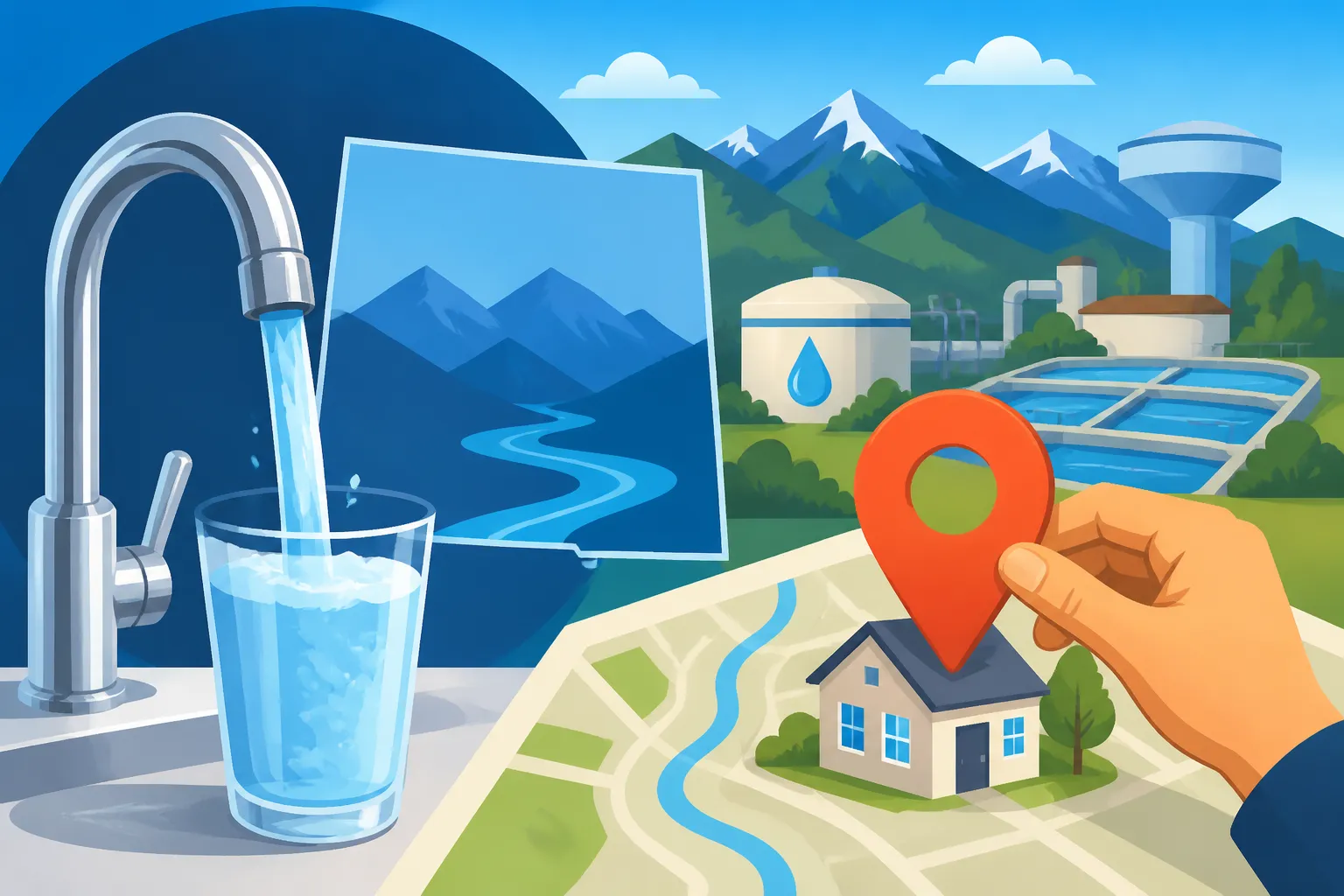
Finding the company or agency that sends water to a Colorado home can be harder than it sounds. City limits, mailing addresses and neighborhood names do not always identify the water provider. This guide explains how to check an address, what records to compare, and what to do when the answer is unclear or the property uses a well.
Start with the address, not the city name
A city name on a mailing address is a useful clue, but it is not proof that the city supplies the water. An address can use a familiar city name for postal purposes while sitting outside the city’s utility service area. Water service boundaries may also differ from city or county boundaries. A nearby home, business or apartment complex may have a different provider.
The goal is to verify who serves the specific property, not merely to identify the nearest water office. That distinction matters when you want a water quality report, need to ask about an outage, are investigating an unusual taste or odor, or are trying to understand a line of pipe leading to the building.
Start by gathering the complete service address. Include the unit number for a condo or apartment, and use the property’s physical location rather than a mailing address if they differ. For a parcel without a standard street address, note the parcel identifier or legal property description if available. You may need those details when asking a utility or property owner to check service.
Keep the following possibilities in mind while you search:
- The property may receive water directly from a city, town, water district or another provider.
- A provider may buy treated water from another system, so the name on the bill may not be the name associated with the source or treatment plant.
- A building may be served by a shared system rather than an individual account for each home.
- A rural property may rely on a private well instead of a public water provider.
- A property may have more than one water source, such as a utility connection for indoor use and a separate well for another purpose. Do not assume either arrangement without checking.
These distinctions can affect which organization can answer a particular question. The entity that bills for water may be different from the organization that treats or wholesales it. And a water provider’s service area does not, by itself, identify every pipe or fixture inside a building.
If you are also trying to understand how municipal tap water is treated and monitored, see Colorado Public Water Systems: How Community Supplies Are Regulated. For background on the types of sources and arrangements that can supply municipal taps, Colorado Municipal Tap Water: Sources, Regulations, and Safety is a useful next read.
Check existing records before searching maps
The fastest starting point is often a document already connected to the property. Look for a recent water bill, a utility account statement, a lease, a closing packet, a service-start confirmation or a notice about water work. These records may show the provider’s legal or operating name, an account number, a service address, or a contact route.
A bill is usually strong evidence of who handles the account, but it may not answer every question. It could show a billing agent, a property manager, a homeowners association or a district rather than the organization that operates treatment facilities. If a name on the document is unfamiliar, use it as a lead: ask whether that organization supplies the water directly, manages billing, or purchases water from another provider.
For a rental, ask the landlord or property manager which provider serves the building and whether water is individually metered, shared across the property, or included in rent. A tenant may receive no separate bill even when the building has a direct utility connection. If the property manager gives only a billing company’s name, ask who operates the water system and who should be contacted about water quality or service problems.
For a home purchase, review the seller’s utility information and the property’s closing materials, but verify the answer independently if a water issue matters to your decision. Records can be incomplete or may refer to a previous owner’s account. A home may also have changed its service arrangement since an older document was created.
Other records can help, but treat them as clues rather than final confirmation:
- A listing description may say “city water,” “district water,” “community water” or “well.” Ask what the phrase means for that exact property.
- A property tax or assessor record may help identify the parcel and jurisdiction, but it may not identify the water provider.
- A neighborhood association or property manager may know how bills are handled, but may not operate the system.
- A nearby property’s bill can suggest a provider, but service boundaries can change across a street or between subdivisions.
- An old water quality report may identify a system, but it may not show whether that system still serves the address.
If you have a utility bill but do not know what the charges mean, High Water Bills for Colorado Renters: How to Check Your Account offers related ways to examine an account. If the immediate question is whether the property is connected to a municipal supplier or relies on a well, Who Supplies Your Tap Water? How to Check Any Colorado Address should be paired with property-specific confirmation rather than treated as a substitute for it.
Use provider searches and boundary maps carefully
Once you have a possible provider name, check its official website for a service-area map, service-address lookup, customer account information or instructions for confirming availability. Search using the full address, including the unit where relevant. If an online result identifies a provider, confirm that it applies to the property itself, not simply to the surrounding community.
A provider’s website may use terms such as “service area,” “district,” “water service,” “customer service” or “new service.” Read the page carefully. A map may show a broad boundary without resolving a particular parcel. A map can also show where a provider has facilities or where it could potentially extend service, rather than confirming an active connection to a specific building.
If an online search does not return an answer, contact the provider directly through the contact information on its official website. Give the complete physical address and ask whether the organization currently supplies potable water there. If the property is new, vacant, subdivided or recently converted, explain that as well. A representative may need to distinguish between a service area and an active service connection.
When several organizations appear to serve the same area, ask each one a narrow question rather than trying to infer the answer from map colors or names. Useful questions include:
- Does your organization currently provide drinking water to this exact service address?
- Is the property connected to your system, or is it only within a possible service area?
- Do you bill the account directly, or does another organization handle billing?
- If you purchase water from another provider, who should customers contact about water quality?
- If the property is not served by you, can you suggest the organization that can verify the address?
A provider may not be able to disclose account information to someone who is not the account holder. That does not necessarily mean it cannot confirm whether an address falls within its service area. If you are a renter, buyer or other person without account access, explain your connection to the property and ask what information it can provide.
Maps from real estate sites, general search engines or commercial address databases can be useful for generating leads, but they may not be designed to establish who supplies drinking water. Use them to identify names worth checking, not as the final authority. If a map conflicts with a current bill or a direct confirmation from the provider, ask the organizations to resolve the discrepancy.
A provider search can also be complicated by a boundary that follows a street, parcel edge or development phase. If a property sits near a boundary, avoid assuming that the map’s apparent line is exact. Ask the provider to check the parcel or address directly. If it cannot confirm, ask what local record or organization can.
Confirm who handles water quality and service questions
The name that appears on a bill is not always the best contact for every concern. A billing office may handle account questions, while a water system handles treatment, quality information, advisories and operational issues. A landlord may collect a shared water charge, while a utility supplies the building. The best first step is to ask the organization what role it performs and where it directs customers for different questions.
Colorado Department of Public Health and Environment recommends that people with concerns or questions about their drinking water reach out to your water system. If you are unsure which system serves the address, first confirm the provider with the property owner, biller or possible utility, then use the system’s official website to find current contact details.
When you reach a provider, be specific about the help you need. “Who supplies this address?” is a different question from “Who can explain this water quality report?” or “Who is responsible for a water-service interruption?” Tell the representative whether you are asking about the water entering the property, a plumbing issue inside the building, a charge on a bill, or a reported advisory. That helps avoid being sent between organizations.
For a quality question, ask for the report or public information associated with the system that serves the address. Do not select a report solely because it covers a nearby city or has a familiar provider name. Confirm that the report applies to the actual supplier, and ask whether the provider can explain how its system relates to the property. Understanding Tap Water Reports: A Colorado Consumer Guide explains what to look for once you have the right report.
If the concern involves a sudden change in taste, smell or color, record what you notice and when it began. Check whether the provider has posted a current notice, but do not use appearance or odor alone to decide whether water is safe. For more on distinguishing a household plumbing issue from a broader concern, see Smell, Taste, or Color: When Is Colorado Tap Water Unsafe to Drink?. If the issue is specifically an unusual chlorine smell after work on the system, Smelling Extra Chlorine in Tap Water After Utility Water Work may help explain what questions to ask.
For an advisory, use the instructions from the provider responsible for the address rather than relying on a neighbor’s report or an unrelated community notice. If you cannot establish which provider serves the property, contact the possible providers and state that you are trying to identify the correct system before acting on a notice. Where Colorado Water Providers Post Alerts and Boil-Water Notices covers ways to check for provider announcements.
Understand what the provider name does and does not tell you
Identifying the supplier is an important first step, but it does not answer every question about water quality or plumbing. A provider can explain information about its system, but water can also be affected by pipes and fixtures between the system and the tap. That is why a water quality report and a household plumbing question are not interchangeable.
A report associated with the provider generally describes the system’s water information, not a diagnosis of every faucet in every building. If you are concerned about an older service line, interior plumbing or a particular outlet, ask what information the provider has about the property and what it can confirm. The provider may know about its portion of a service line but not the materials of plumbing inside a home.
For questions about a line running from a public main toward a building, clarify which portion you mean. The ownership and maintenance responsibilities can differ along the route. A provider may have information about public infrastructure, while a property owner or manager may need to check the building-side pipe. Water Service Lines in Colorado: Who Owns Which Side of the Pipe? and Unknown Service Line Status in Colorado: How to Check Your Pipe provide relevant context.
Do not assume that the utility’s name settles whether a home needs a filter or treatment device. First identify the system, obtain the relevant water information, and be clear about whether the concern is the source, a service line, an indoor pipe or a taste preference. A treatment choice should match a specific, verified concern rather than a generic claim about an entire city or region. Reading Your Water Quality Report: Do You Really Need a Filter? discusses how to connect a report to a household decision.
Similarly, a notice posted by one provider does not automatically apply to an address served by another system. If the property is close to a boundary or receives water through a shared arrangement, ask the provider to confirm whether the notice covers that address. Do not infer coverage from the town name printed on a mailing address.
The provider may also explain where its water comes from or whether it purchases water from another organization. That information can be useful, but the source, wholesaler, treatment operator, billing entity and retail provider are not necessarily the same. Ask which entity is responsible for customer communication and which system’s report is relevant to the tap.
If the property uses a private well or shared arrangement
A rural address may not have a municipal water provider. It may rely on a private well, a shared well, or another arrangement managed by a property owner or group of users. In those cases, searching city and district maps may not identify a company that supplies the tap. The property’s water source needs to be confirmed directly.
For a private well, ask the current owner, landlord or property manager where the well is located and which building or buildings it serves. If you are buying, request available well records and recent water test results, and ask who maintains the pump and related equipment. A well permit or a record showing a well exists does not, on its own, establish that the well currently supplies the home or that its water has been tested for the concern you have.
For a rental on a well, ask who is responsible for routine maintenance, testing and arranging repairs. If the landlord is unsure, request clarification in writing. The arrangement may be different from a home served by a utility, where a provider can answer system-level questions. A private well owner may need to arrange testing independently and select a qualified laboratory for the issue being investigated.
For a shared well or community arrangement, find out who manages the system and how users receive notices. Ask whether the water is supplied through a formal provider, managed by a property association, or maintained under an agreement among property owners. Obtain the current contact route for the person or organization responsible for the system. Do not assume that a shared system’s administrator is the same as the company that bills for water.
If the records are unclear, compare the property’s documents with what the owner or manager says. A well shown in a record could be inactive, abandoned or unrelated to the building’s current supply. Conversely, a property may use a well even if the listing uses a broad phrase such as “community water.” Ask directly which source reaches the kitchen tap and whether other water sources are present.
Well water questions often require a different path from municipal water questions. Testing Private Well Water in Colorado: What Contaminants to Check outlines why a well owner may need testing that is specific to the property. For a property purchase, Buying a Colorado Home With a Well: Test Results to Review can help organize questions about existing results and records.
If you cannot determine whether the property is on a well or a public system, ask the owner or manager first, then contact any likely provider with the precise address. A provider can tell you whether it serves that location, but it may not have records for a private well. The property owner or manager is often the best source for the well’s operating and maintenance history.
A practical process for resolving conflicting answers
Sometimes the first search produces two provider names, an old bill, an unclear map and no direct confirmation. Rather than choosing the most plausible answer, keep a short record of what each source says and use that information to ask a more specific question.
- Write down the full physical address, including the unit or parcel information needed to distinguish the property.
- Note the name shown on the most recent bill, lease or property record, along with the date or context of that document.
- Check the possible provider’s official website for a service-address tool or map, but treat an unverified map result as a lead.
- Contact the provider and ask whether it currently supplies drinking water to that exact address.
- If it does not, ask whether it knows which provider or system serves the property.
- If the property is rented or shared, ask the owner or manager to identify the actual water source and the organization responsible for notices.
- If the answer remains uncertain, contact the other likely provider and ask it to check the same address.
- Keep the confirmation and the provider’s current contact route with the property’s utility records.
If a provider says the property is outside its boundary while a bill names that provider, ask whether the bill is for a different service, a former account or a billing arrangement. If a map shows service but the provider cannot find an active connection, ask whether the map describes a general service area rather than an existing account. If an owner says the home has well water but a bill suggests a utility connection, ask whether both sources are present and which one supplies the indoor taps.
For a multifamily building, distinguish between the building’s water service and the way costs are divided among residents. A shared bill or submetering arrangement may make the account holder different from the person who uses the water. Ask who receives provider notices and whether residents are told about advisories or planned work. If a property manager passes along a message, confirm that it came from the provider responsible for the building.
When you call or write, state what you are trying to verify and what evidence you already have. For example: “I have a bill with your name, but the service-area map appears to exclude this parcel. Can you confirm whether your system supplies this address, and if not, whether you can identify the correct provider?” A focused question is more likely to resolve a discrepancy than a general request for information.
Keep the final answer in a place that future occupants can find: save a provider confirmation, keep a bill or service-start record, and note whether the property uses a private or shared well. This is especially useful during a move, a sale, a change in property management or a later water-quality concern. If the provider changes, repeat the check rather than assuming the old record still applies.
Frequently Asked Questions
Does a Colorado mailing address tell me who supplies the water?
No. A city name in a mailing address can be a clue, but it does not confirm the water service area or an active connection. Check a recent bill, the provider’s official address information, or ask the possible provider directly.
Is the organization on my water bill always the water system?
Not necessarily. It may handle billing or account administration, while another organization operates the system or supplies treated water. Ask what role the organization performs and who handles water quality and service questions.
What if I rent and do not receive a water bill?
Ask the landlord or property manager who supplies the building, who receives provider notices and where to direct a water-quality or service question. A shared building account can mean the tenant does not see the provider’s bill.
What if I cannot find a provider for a rural address?
Ask the owner or manager whether the property uses a private or shared well, then request any available system, maintenance and testing records. A utility boundary search may not identify a private well.
Should I use a nearby home’s provider as confirmation?
Use it only as a clue. A nearby property can have a different provider or water source. Verify your exact service address with the provider or property owner.
Sources
- Colorado Department of Public Health and Environment — Drinking water consumer information and data | Colorado Department of Public Health and Environment (checked November 13, 2026)
Disclaimer
This article is for general informational purposes only and does not constitute professional advice. Laws, prices and regulations vary by location and change over time. Consult a qualified professional for guidance on your specific situation. Colorado Water Guide is not a government agency or water utility and is not affiliated with any public water system.